


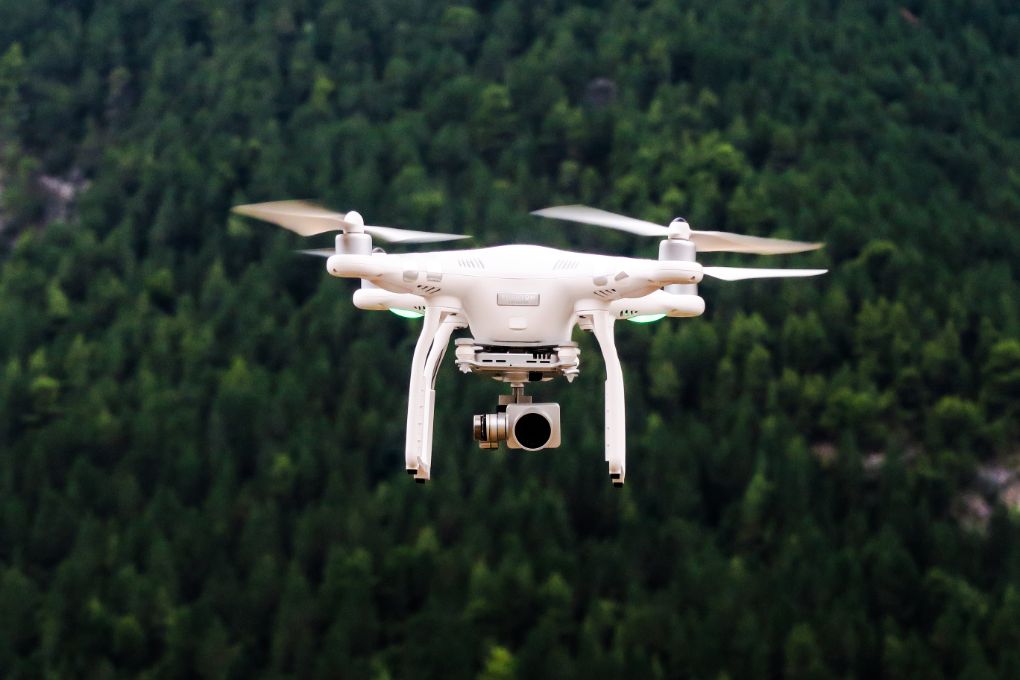
Hardly anyone has doubts that technology is developing at a rapid pace. Also in such traditional fields as crop cultivation, various technological innovations are increasingly being used. Check how drones can be used in hemp cultivation!
What will you learn from this article?
👉 How are drones used in hemp cultivation?
👉 What will the future of hemp cultivation look like?
Table of contents:
Difference between female and male plants
To understand how important a role drones can play in hemp cultivation, you need to learn the difference between female and male plants. Well, only female plants are able to produce flowers, which can later be used in many different ways. It is from them that valuable cannabinoids are extracted.

What is the role of male plants? They produce so-called pollen sacs, which are used for reproduction. Unfortunately, the role of male plants ends there. A large number of male plants negatively affects the quality of the crop, because it results in fewer flowers from female plants in the harvest.
The problem, however, is that distinguishing between male and female plants before flowering is almost impossible. And when flowering occurs, it is already too late. For this reason, growers try to cultivate only female plants and attempt to remove the male ones. The longer a female plant remains unpollinated, the larger it will be – and therefore will allow for the production of a larger number of flowers.
It is easy to guess that for a grower, this means greater profit. At the same time, the final product will also be of better quality.
How can drones help?
Companies engaged in the cultivation and processing of hemp are eager to use new technologies. An interesting example could be the Irish company Greenhouse CBD. It partnered with Canadian company Zenadrone, which develops various types of drones. This time Zenadrone faced an interesting task.
It had to create a drone equipped with artificial intelligence that will be able to distinguish male plants from female plants even before the flowering period. That’s not all – drones are also supposed to remove male plants!
Thanks to the use of drones, the cultivation will not contain male plants, or will contain a minimal amount of them. Thanks to this, plant growers can achieve much better results, and the amount of flowers obtained can be much larger than in a situation where male plants are also present in the cultivation.
However, the task of drones does not end there. Thanks to the camera system, drones collect information about plants and then transmit it to a huge database. The farmer can therefore optimize the hemp cultivation process, achieving increasingly better results.



Drones for hemp cultivation also in Poland
Polish companies have repeatedly proven that they are not lagging behind their foreign competition. It is the same this time. The Polish hemp company Alba Konopie SA can boast of rapid development, also thanks to investors. The company has very ambitious plans.
These include, among other things, the creation of a machinery park, which will be dedicated to the cultivation and processing of hemp plants. And in this case, drones are primarily to serve to find and remove male hemp plants.
That’s not all – the company also plans to use other equipment, such as a hemp harvesting machine, a modular scalable dryer or a decorticating machine. Interestingly, in the future Alba Konopie wants to offer a drone service to hemp breeders in Poland and other countries. Undoubtedly, this is an interesting concept for diversifying revenue in a company whose management is distinguished by strong business competencies.


What will the future of hemp look like?
The world around us is being constantly digitalized. Technological development does not bypass hemp either, as evidenced by the use of hemp to improve crop quality. It can be predicted that in the coming years, drones – and not only – will allow, among other things, the creation of plants with strictly defined cannabinoid profiles.
It is also worth remembering that the potential of hemp is enormous – and this is not just about recreational use of dried flowers, dietary supplements or cosmetics.
Hemp can be used in industry, in the production of clothing, paper, and even plastic made from hemp – which, given today’s threat of ecological catastrophe, gains enormous importance. For this reason, improving methods of hemp cultivation becomes even more significant.

 (4.7/5)